

In Part 1 of this series, I introduced the Sitecore Marketplace SDK—unveiled at SUGCON Europe 2025—as Sitecore’s latest step toward openness and developer empowerment. I explored how the SDK enables secure, composable integrations with XM Cloud and the wider Intelligent DXP ecosystem, making it easier than ever to create pluggable apps that feel native to the Sitecore platform.
Now, in this follow-up, let’s take it a step deeper. This post focuses on the architecture behind the SDK.
Modular Architecture Overview
The Sitecore Marketplace SDK is built on a modern, layered architecture using a monorepo structure. This allows Sitecore to maintain clean separations of concern, accelerate development workflows, and ensure maximum security.
The three key packages:
- Core SDK – the foundational communication layer
- Client SDK – a developer-friendly abstraction for frontend frameworks
- XMC Module – Sitecore-specific API integrations (focused on XM Cloud)
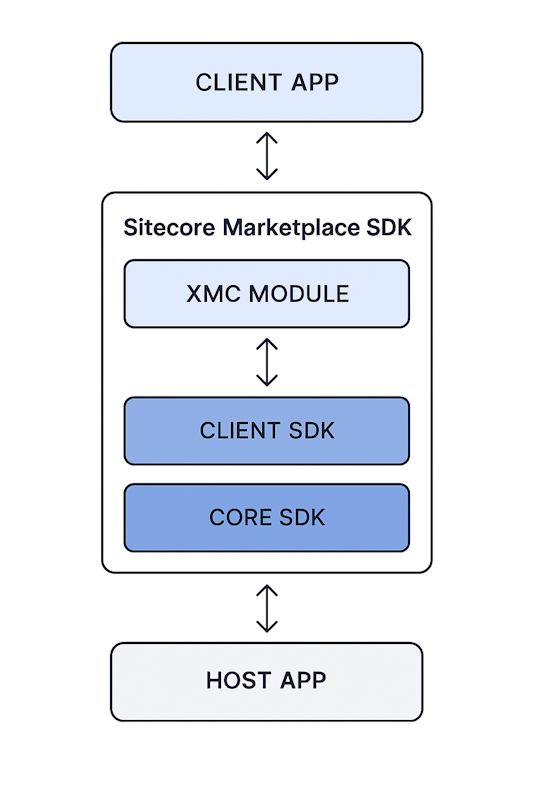
Core SDK: The Secure Bridge
The Core SDK is the lowest-level layer of the SDK stack. Its job is to abstract away the complexity of using the browser’s postMessage API, providing structured request/response messaging and event-based pub/sub (or in other words publish-subscribe).
Key Features:
- Secure handshake to validate trusted clients
- Structured message types with timeout and retry support
- Publish/subscribe event bus for real-time updates
- Origin validation for security
At its heart is the PostMessageBridge, a class that standardizes messaging in a type-safe, reliable manner.
Client SDK: Simplifying Development
Built on top of the Core SDK, the Client SDK provides a modern abstraction layer ideal for React or Vue applications. It offers APIs that resemble React Query or Apollo Client patterns:
- useQuery() and useMutation() for async data operations
- Built-in loading, error, and caching state
- Hook-based API design for readability
It removes the need to manually manage low-level messaging, allowing developers to focus on building UI and business logic.
XMC Module: Purpose-Built for XM Cloud
The XMC Module extends the Client SDK with Sitecore-specific integrations. It offers prebuilt APIs to work with Experience Edge, authoring environments, and GraphQL endpoints.
Use Cases:
- Querying content items by language or taxonomy
- Updating settings or publishing status
- GraphQL queries with schema inference for autocompletion
Together, these layers allow developers to start with only what they need:
- Use Core SDK for custom messaging
- Use Client SDK for frontend apps
- Use XMC Module for deep Sitecore integration
What’s next?
Now that I’ve explored the architecture behind the Sitecore Marketplace SDK, it’s time to look at how all the layers come together during runtime.
In the next post, I’ll break down the communication flow between client and host, explain the distinct roles each side plays in the SDK model, and give you a peek into the tooling and modern JavaScript setup in the SDK.
Happy Sitecore-ing!
–Robbert